Introduction
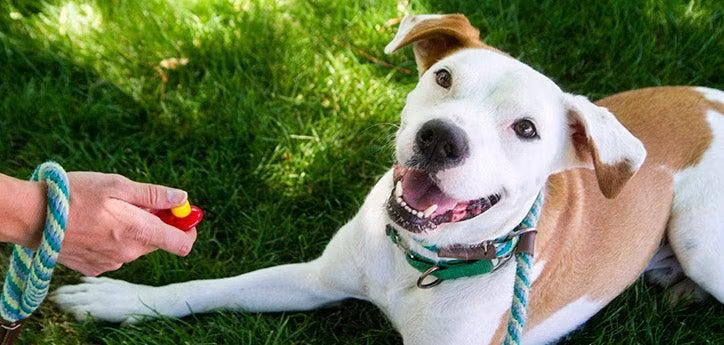
Once your dog understands the magic of the click — that crisp sound that means “Yes, you got it!” — you can move from basic obedience into complex, creative behaviors. Welcome to Clicker Training 201, where timing, shaping, and problem-solving come together to unlock your dog’s full potential. Whether your goal is agility, therapy work, or just an impressive high-five, advanced clicker training turns learning into a fun, cooperative game.
1. The Power of Precision
In basic clicker training, you mark simple actions like “sit” or “down.” In advanced training, the click becomes a tool for communication at micro-levels. Every click pinpoints the exact moment your dog makes progress — even a tiny step toward a goal.
- 🎯 Micro behaviors: Reward partial movements that lead to complex actions.
- 🧩 Chains of behavior: Combine small steps into fluid sequences.
- 💬 Clear communication: The click tells your dog precisely when they’re right — no confusion, no guessing.
Pro Tip: Think of your click as a camera shutter — you’re “capturing” the exact behavior you want to reinforce.
2. Shaping: Building Behavior Step-by-Step
Shaping means teaching your dog a new behavior by reinforcing small, successive steps toward the final goal. It’s how you get from a head turn to a full spin, or from paw movement to closing a door.
- Start with a goal (e.g., “touch the light switch”).
- Click for small approximations — turning toward the switch, moving closer, sniffing it.
- Gradually raise the bar — only click for progress toward the finished behavior.
Pro Tip: Patience pays off. Don’t rush between stages — let your dog discover the behavior through curiosity and problem-solving.
3. Backchaining Complex Behaviors
Backchaining is a technique where you teach the last step of a sequence first, then work backward. It’s a favorite method among professional trainers because it helps dogs understand the final reward faster.
- Example: Teaching your dog to fetch a toy, put it in a basket, and close the lid.
- Train closing the lid first → then dropping the toy → then fetching it.
By mastering the end goal first, your dog stays motivated through each new layer of learning.
4. Using Targets and Props
Advanced clicker training often uses targeting — teaching your dog to touch or interact with an object. Start with a simple hand or stick target, then build up to props like cones, mats, or boxes.
- 👉 Hand target: Teach “touch” to guide movement or focus attention.
- 🎯 Station training: Teach your dog to go to a mat and stay — perfect for impulse control.
- 🧺 Object interaction: Use props to teach tricks like “push,” “pull,” or “stack.”
Pro Tip: Add variety! Dogs thrive on novelty — use different objects to strengthen problem-solving and confidence.
5. Adding Cues and Duration
Once your dog reliably performs a behavior, it’s time to add verbal or hand cues. Remember — the cue comes *before* the behavior, not during or after.
- Say the cue (“spin”) just before your dog starts performing the action.
- Click and reward when they complete it.
- Repeat until your dog connects the cue with the behavior.
Then, build duration — for example, extend a “stay” from 3 seconds to 30 seconds by clicking for longer holds.
6. Variable Rewards: Keeping It Interesting
Once a behavior is solid, switch to a variable reinforcement schedule — rewarding randomly instead of every time. This mimics how dogs learn in real life and keeps motivation sky-high.
- 🎲 Click every time, but treat unpredictably.
- 🎯 Occasionally replace treats with play or praise.
- 💡 Use jackpot rewards (extra treats or a big game) for major breakthroughs.
Pro Tip: Random rewards make behaviors stronger — your dog will work harder not knowing when the “big win” is coming.
7. Problem Solving and Creativity
Once your dog understands clicker logic, you’ll notice something amazing — they start offering new behaviors on their own. This is called operant thinking — your dog realizes they can influence outcomes through action.
- 🤔 Encourage curiosity — click creative attempts toward your goal.
- 🎭 Build unique tricks like “wave,” “bow,” or “spin twice.”
- 🧠 Use props to create challenges — boxes, hoops, or small obstacles.
Pro Tip: Don’t over-correct mistakes. In shaping, a “wrong” move is just another step toward discovery.
8. Emotional Control and Focus
Advanced training isn’t just physical — it’s mental. Use clicker work to build calm focus under distraction. Reward moments of stillness, soft eye contact, and relaxed posture. This balance between excitement and self-control creates emotionally intelligent dogs who can work calmly anywhere — from agility rings to therapy sessions.
9. Transitioning Away from the Clicker
Once your dog consistently performs complex behaviors, you can gradually fade out the clicker. Replace it with verbal markers (“Yes!”) or intermittent reinforcement.
- Step 1: Use both click and verbal cue together for a few sessions.
- Step 2: Phase the click out — rely on “Yes!” or “Good!” as confirmation.
- Step 3: Maintain enthusiasm — praise still matters as much as treats.
10. The Joy of Advanced Learning
Clicker training at this level is more than obedience — it’s teamwork and creativity in action. Your dog becomes an active thinker, solving puzzles and engaging with you in a shared language. It’s rewarding, intellectually stimulating, and deeply bonding — proof that learning can be as joyful as play.
Conclusion
Clicker Training 201 turns good dogs into great learners. With patience, timing, and a playful spirit, you can shape behaviors limited only by imagination. From fetching specific toys to dancing routines, each click becomes a bridge — one that strengthens trust, communication, and connection between you and your dog. 🐾🎯